Sal'kiirans
Created by Captain Easton Lawe on 22 Nov 2022 @ 6:26pm
The Sal'kiirans are a warp-capable humanoid species inhabiting the planet of Sal'kiir in the Kiir System.
1) History
1.1) Origins on Sal'kiir
The people of Sal'kiir know that they are not truly native to the system they live in, but they also know that it has been such a long time that it doesn't really matter. Many, many centuries ago, their people migrated from a star system the entire race has forgotten and settled on this temperamental world of extremes. If there was a native dominant race at the time, it has been lost to their history. They know from their genetic studies that their race has always had a natural ability to adapt, and as such, their entire people has adapted physiologically to the areas where their ancestors chose to settle.
It's created four distinct versions of one species, each relevant to the environment they have lived in for so long: the aqueous jungles, deep inside the mountains, high atop them, and in the unforgiving deserts. They are known as the Qaiins (Jungle/Water), the Chaarans (Desert/Fire), the Hylcins (Subterrean/Earth), and the Arrkuns (High Altitude/Air).
1.2) Space Travel
The Sal'kiirans achieved warp capability in 1918 (by the Sol calendar) and have been known to the UFP since 2372, although they had no interest in becoming a part of the UFP at that time. Relations were cordial, however, and trade routes to and from Sal'kiir were established although rarely utilized given the distance from the bulk of Federation territory.
1.3) UFP Membership
However, things changed when a new invention of the Sal'kiiran came to the knowledge of their universal neighbors in late 2418. The Arrkun Institute of Engineering had discovered a potential new engine system, which would give ships the speed of quantum slipstream without using the same amount of space or resources. Once this became known, many planetary governments were interested--including the Federation. In Early 2020, the Sal'kiiran Planetary Council chose the UFP to work with. As such, they required the assistance and possible protection of their new allies from races unhappy with their choice.
They were granted membership in an expedited process and agreed to allow their newly terraformed planet of Hya'kiir to be the site of a Federation colony as well as a starbase built in orbit of Sal'kiir itself.
2) System & Planets
2.1) Kiir
Type-G Yellow Dwarf. It's larger than Sol.
2.2) Sal'kiir
This is a Class-M world but a more intense version than most. It could be called a terribly extreme version of Earth. It houses all the same sorts of terrain, but each one is dramatically more intense: the deserts are hotter, more arid, and even fiery or explosive, the mountains denser and higher, and the jungles are so humid that one practically walks through water.
A day on Sal'kiir is twenty-one Earth hours and it takes Sal'kiir 284 Earth days to orbit its sun. The seasons vary greatly depending on the region, but on average, there are only three: the hot season, the season of change (akin to autumn) and the cold season.
2.3) Hya'kiir
Class-D World, Terraformed to Class-M. Less extreme than Sal'kiir. Longer year, longer days.
2.4) Jin'kiir
Class-D World, Terraformed to Class-M. Less extreme than Sal'kiir. Longer year, longer days.
2.5) Kiiran Field
Mineral-dense asteroid field. It's mined by the citizens of Ehl'kiir.
2.6) Ehl'kiir
Class-Y World, Colonized by Dome Systems. This planet has one season: hell. It cannot be terraformed, but a dome system was created to survive it and Sal'kiirans are so far, the only people able to tolerate the atmosphere even within the domes. The citizens of this planet are the ones responsible for mining the Kiiran Field and sending their goods back to the other worlds for various technologican and mechanical devices.
3) Physiology
3.1) Sal'kiiran
All Sal'kiirans are humanoid, carbon-based, mammalian life-forms with two biological sexes. Over the centuries inhabiting the extreme world of Sal'kiir, each region type has developed its own "subset" of the Sal'kiiran species. There are traits they all share, but then variances based on the region their ancestors hail from. Some differences are minor, while others require some level of medical intervention for one region's people to travel to another.
Sal'kiiran females carry the young after being impregnated by a Sal'kiiran male. They carry the young in a womb with a placenta, like many species, and mothers produce milk for the young. The length of term varies between regions, as does the nutrional content of the milk produced. Milk between regions may keep a baby alive, but they will not thrive if it's not from their own regional subset.
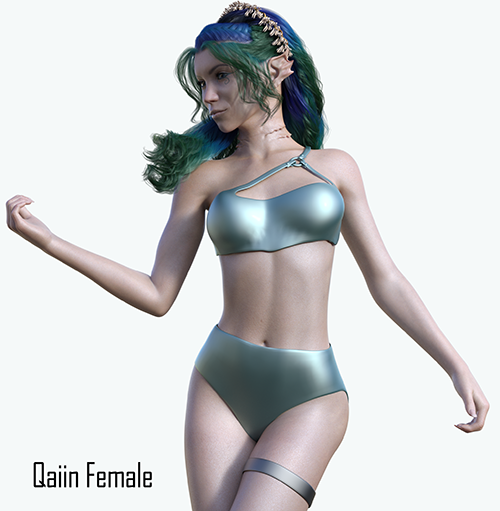
3.1.1) The Qaiins (Jungle/Water)
The range of height for the Qaiins varies greatly, but their bodies are always slender to allow for more dynamic movement in the water. They have enlarged lungs (compared to the Chaarans or Hylcins), a very efficent oxygenation/circulation system, and a set of gills on their neck. These all allow them to breathe air on land as well as underwater in the highly-oxygenated waters of the Sal'kiiran jungles.
Their coloring is pale, almost silvery and they have subcutaneous mucus glands in various places on their body that secrete a thin mucus substance to keep their skin wet. As such, they constantly appear wet, and these glands increase production when they enter a dryer atmosphere. (This is basically anywhere that is not the very humid jungles they inhabit.) The coloring of their eyes and hair tend toward aquatic shades of blue to green.
They are omnivores, although subsist primarily on plant material and fish.
Qaiins give birth underwater. Similar to human newborns, babies do not start breathing until their skin touches the air. Their natal terms are the longest of all the regions, averaging eight solar months. Plural births are common, and the Qaiin are very fertile. Qaiin children reach sexual maturity around fourteen solar years of age. It's not uncommon for Qaiin youth to remain with their families well into adulthood, including after they have their own children--living in generational households with as many as four generations together. The average lifespan of a Qaiin is between ninety and one hundred solar years.
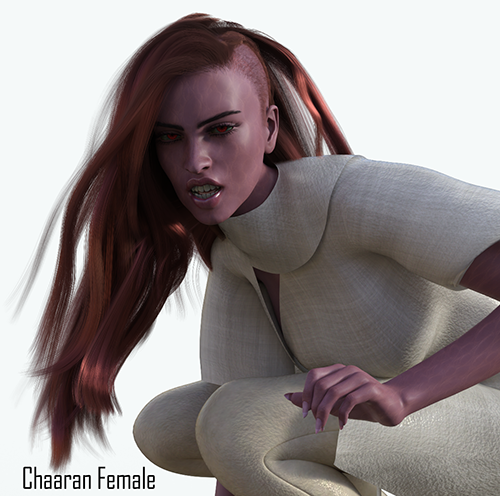
3.1.2) The Chaarans (Desert/Fire)
The range of height and weight varies for the Chaarans. Their skin is covered in reddish scales, although they are only visible from close-up. Otherwise, their just appears to be varying pale shades of pick, red, or orange. These scales have the biological function of being able to absorb water, which is useful when water is in small quantities or difficult to reach areas. Their eyes and hair tend in shades of red as well, matching the colors of the desert sand around them.
They have long eyelashes and thick brows to help block sand from reaching their eyes, but they also have a nictitating membrane or 'second eyelid' that they can open and close at will. Their nostrils can be closed at will as well.
They are able to enter a semi-hibernational state in extreme heat. The deserts are very arid, so they do not like humidity, but medical intervention is rare. They are also primary carnivores. They can digest planet material in small amounts, but it can frequently cause digestive upset.
Natal terms of Chaarans average about five solar months, and the children reach sexual maturity by the age of ten solar years. Chaaran mothers leave their young to fend for themselves at the earliest possible time, which is usually around eight years. The average lifespan of a Chaaran is between sixty and seventy years.
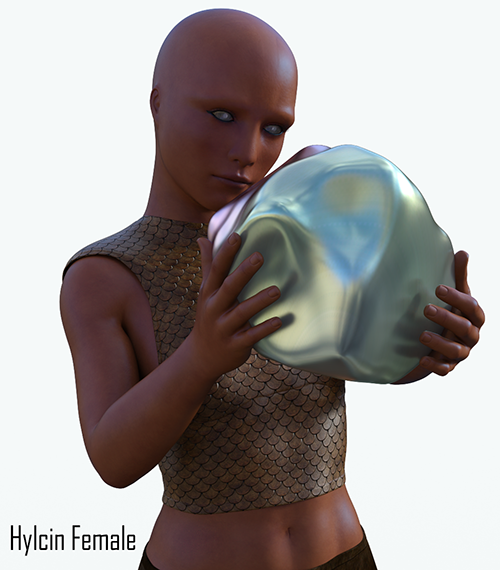
3.1.3) The Hylcins (Subterrean/Earth)
The Hylcins are all short and strongly built. Their eyes are milky in color, adapted for low light or even seeing in the dark. If they leave their subterrean home, it requires a special set of lenses or large glasses. The shade of their skin varies from brown to gray, much like the soil and stone they live in, and is thicker than any other Sal'kiiran's. Their external ears are small or non-existent.
Their bodies have less thermal conduction, to help cut down on heat buildup in underground spaces, and they are able to pick up on seismic/percussive waves through dirt or rock.
They are omnivores with a diet balanced between meat and plant material, including a wide range of fungi.
Hylcin females carry their mammary glands more internally than other Sal'kiirans so the female breasts are small to non-existant, and it's difficult to tell male from female apart on visual inspection alone. The natal term tends to be on average of seven solar months, with the children reaching sexual maturity around fourteen. The average lifespan of the Hylcins is between one hundred and ten and one hundred and twenty years old.

3.1.4) The Arrkuns (High Altitude/Air)
The Arrkuns are tall and slender, with pale coloring to their skin, hair, and eyes. They have a thick layer of subcutaneous fat spread evenly over their body along with a layer of thick, short, almost translucent fur to survive the lower temperatures of their high-altitude homes. Like their Qaiin counterparts, they also have larger lungs but also larger hearts, which allow for more efficient use of oxygen. They have almost no sweat glands and are unable to tolerate heat, so they require medication to travel away from their cities to tolerate the temperature but they get a boost from the extra oxygen.
They are vegetarians, but primarily survive on synthesized foods.
The average natal term is seven solar months, and they reach sexual maturity the latest of all the Sal'kiiren people at around twenty solar years. Their average natural life span is between ninety and one hundred, but they have used consistent technological advances to increase that by as much as ten to thirty years.
4) Society and Government
4.1) Sal'kiiran
Each region has its own style of governing their people, even though there are multiple areas for each region type, but they all acknowledge an overriding planetary governing body that has its seat of power in the capital city and is ruled by a council made up of persons from every region. If any one region does not have a representative, there is no ability to make decisions. (Quorom?)
4.1.1) Water
(Oligarchy.) The Qaiins are ruled by a triumvirate. Members can be male or female, and they are called the Council of Three.
4.1.2) Fire
(Anarchy.) There is no governing body of the Chaarans outside of the city. Every denizen of every desert is on their own.
4.1.3) Earth
(Monarchy.) The Hylcins are ruled by a single monarch with a council of advisors. This monarch can be male or female and goes by the title Phiri, which translates to Sovereign.
4.1.4) Air
(Democracy.) Each Arrkun city votes to elect two representatives that govern the Arrkun people from Ternea, which is the Arrkun city atop the hill outside the Sal'kiiran capital.
5) Culture and Technology
5.1) Sal'kiiran
Every Sal'kiiran city is a mixture of all the regions and all the people. Various individuals from every region choose to leave their native space and move to the cities, where they live in a mix of cultures and climates. (The individual climate of each city is influenced most by whether its built near a jungle or a desert.) Each city has a ruling council of four, which answer to the planetary council in Ozul. These councils are sometimes requested to step into regional disputes.
5.1.1) Water
The Qaiins have access to technology but as a culture, they have chosen to forgo it. They live entirely in tune with the nature around them. (Humans will compare them to medeival era/Europe on Earth.) All homes are built near bodies of water, and they use materials that will withstand the intense humidity of the jungle, different woods and plants. Villages and the larger towns may or may not be on the water's edge like houses are. There are dirt roads connecting villages and bodies of water with houses by them.
Qaiin society is matriarchal and family-oriented. Polyandry is a natural order to control population in the otherwise very fertile Qaiin population, and they have no issues with nudity. It's not unusual to see them swimming or even around their homes without any clothing on.
There is a common animal that looks like an Earth horse, but it has somewhat splayed, multi-cloven hooves with webs between them and gills on their necks like the Qaiins. There is a common vegetable crop with a name that cannot be properly translated, but it is described by humans as a combination of an apple and a squash.
5.1.2) Fire
The Chaarans have not forsaken technology, but with no centralized anything or much cooperation, the level of technological advancement depends on each Chaaran's ability to attain it and that technology's ability to survive in the desert heat.
Like the fiery, sometimes explosive deserts they inhabit, the Chaarans are an emotionally-volatile people and quick to anger.
5.1.3) Earth
All Hylcin cities are built inside of mountains. Technology is common and advanced, but only if it can be incorporated into the mountains without damaging it. As a people, they pride themselves on living "in sync" with their mountain homes. They habitually refer to mountains as if they were fellow living beings. Tribal-style drum music is common among the Hylcins with drums that are short and flush against the ground, so the percussive force can be felt through the soles of their feet.
A common food in the mountain cities is "norvet," which is a type of rodent roasted on a skewer on top of super-heated rocks. This animal is very common in Hylcin cities and humans say that it tastes like chicken. There is also a metal frequently mined from the mountains called "kainen," which is multi-colored and used for jewelry and other trinkets. The metal is also useful in certain types of technological devices, so the metal as well as the crafts made from it are big exports from inside the mountains.
Hylcins are a very pragmatic people, although they take offense easily if something is said or done to their mountain home that they do not feel is in sync.
5.1.4) Air
The Arrkuns are naturally individually-minded and somewhat aloof. Technology is a huge, integral part of their lives, and they are always seeking to improve what exists and invent what is new. The architects behind almost every city on the planet is an Arrkun, and they have always been the leading force behind air and space travel. Their cities tend to be architecturally all straight lines in shades of light blue and white.
The Arrkuns also almost all have tattoos on their hands, arms, and faces. It's a tradition that they are not entirely sure why it started and yet, in contrast to their technology-minded ways, they maintain.
7) Religion and Spirituality
7.1) Cities
In the cities, there is a varied mix of the major and minor religions from every region. The temples or priests, or whatever terms are used, can be found here depending on the populace of that city.
7.2) Water
The majority of Qaiins are naturalistic polythiests and believe their gods exist in the waterways and the trees that make up their jungle home. There are minorities of athiests and panthiests ("all is god").
7.3) Fire
There is not majority known for the Chaarans, given there is no "group" structure to them in the deserts. For those that live in the cities, they gravitate toward spirit worship around the fire element and polytheism.
7.4) Earth
The majority of Hylcins are pantheists, while some are monotheists and others practice a form of ancestor worship.
7.5) Air
The majority are Arrkuns are athiests, closer to worshiping their technology than anything supernatural. Some are monotheists, although each monotheistic religion is different between the regions. (Consider it comparable to Christianity and Judaism.)
8) Language
8.1) Common
There is one Sal'kiiran language that has been adopted in the past several decades across the planet as interstellar travel and visitors became more common, however there do remain languages within each region and different dialects of the common language have also developed over the years.
9) Locations
9.1) The Capital City
The capital city of the planet Sal'kiir is named Ozul, and it is the primary destination for guests from NAME Station who do not have specific business elsewhere. Two-thirds of the city is bordered by jungle, while the remaining third north/northeast, is bordered by a mountain. The Hylcin city of Haryn resides within the mountain, while the Arrkun city of Calose lives far up it. There are roads leading into the jungle, which becoming increasingly more rural as you go; there is a small, open-air transport that can take you to the Hylcin city; and there is also a tram that travels from the north edge of Ozul up to Calose. This tram is comparable to a closed-in ski lift from Earth, operating on a cable system. (It is designed to interest tourists rather than a lack of technology.)
In almost the direct center of the city is the primary hotel that caters to both natives and tourists. It's name is Gehr'tahn, which is loosely translated as 'Welcoming Other.' There is no direct translation for "tahn" from Sal'kiiran to Standard, but it's an approximate meaning. The hotel is made of several multi-level buildings, all connected by tunnels between them. Upon checking in, each visitor receives a stamp on their wrists that allows them to unlock the doors to their rooms. The stamp wears off in several days.
The city itself, colored in white and silver, stands in stark contrast to the verdant nature that surrounds it. But while the buildings are monotone shades, everything else about the city--from the people to the natural elements--tends to be very colorful. The city structures are many slightly rounded buildings, some of which resemble pods more than buildings, and many climbing quite high. The windows are numerous and large, though slightly tinted so you can't see inside. There is an element in the materials of the buildings themselves that dampens ambient noise, giving the city a feeling of quiet despite being busy.
There is a river-walk in the city. The long path--about four people wide--curves along the left side of a river that runs through the city. This left side is paved with a rustic, indigo-colored stone that does not look 'normal' (or occuring naturally) to anyone not born on Sal'kiir but it is entirely natural and mined from one particular mountain range in the southern hemisphere. While the buildings are monotone shades of white and silver, everything else about the city--from the people to the natural elements--tends to be very colorful.
A short walk from the hotel is a bar/night club called Haralor. It tends to be crowded, dark, and filled with actual smoke that humans claims smells vaguely of sandalwood.
When venturing into the jungle, there is a modern bar just outside the city and then a village not much further in. There is a tavern in the village that is popular for tourists, and a few cabins by a lake's edge that the Qaiin village rents to tourists. On the western side of the village is where the can'alla bloom--a rainbow-hued flower that grows in large swaths, about knee-high with a shimmering tone. When its the blooming season, it is a very popular place to visit.
1) History
1.1) Origins on Sal'kiir
The people of Sal'kiir know that they are not truly native to the system they live in, but they also know that it has been such a long time that it doesn't really matter. Many, many centuries ago, their people migrated from a star system the entire race has forgotten and settled on this temperamental world of extremes. If there was a native dominant race at the time, it has been lost to their history. They know from their genetic studies that their race has always had a natural ability to adapt, and as such, their entire people has adapted physiologically to the areas where their ancestors chose to settle.
It's created four distinct versions of one species, each relevant to the environment they have lived in for so long: the aqueous jungles, deep inside the mountains, high atop them, and in the unforgiving deserts. They are known as the Qaiins (Jungle/Water), the Chaarans (Desert/Fire), the Hylcins (Subterrean/Earth), and the Arrkuns (High Altitude/Air).
1.2) Space Travel
The Sal'kiirans achieved warp capability in 1918 (by the Sol calendar) and have been known to the UFP since 2372, although they had no interest in becoming a part of the UFP at that time. Relations were cordial, however, and trade routes to and from Sal'kiir were established although rarely utilized given the distance from the bulk of Federation territory.
1.3) UFP Membership
However, things changed when a new invention of the Sal'kiiran came to the knowledge of their universal neighbors in late 2418. The Arrkun Institute of Engineering had discovered a potential new engine system, which would give ships the speed of quantum slipstream without using the same amount of space or resources. Once this became known, many planetary governments were interested--including the Federation. In Early 2020, the Sal'kiiran Planetary Council chose the UFP to work with. As such, they required the assistance and possible protection of their new allies from races unhappy with their choice.
They were granted membership in an expedited process and agreed to allow their newly terraformed planet of Hya'kiir to be the site of a Federation colony as well as a starbase built in orbit of Sal'kiir itself.
2) System & Planets
2.1) Kiir
Type-G Yellow Dwarf. It's larger than Sol.
2.2) Sal'kiir
This is a Class-M world but a more intense version than most. It could be called a terribly extreme version of Earth. It houses all the same sorts of terrain, but each one is dramatically more intense: the deserts are hotter, more arid, and even fiery or explosive, the mountains denser and higher, and the jungles are so humid that one practically walks through water.
A day on Sal'kiir is twenty-one Earth hours and it takes Sal'kiir 284 Earth days to orbit its sun. The seasons vary greatly depending on the region, but on average, there are only three: the hot season, the season of change (akin to autumn) and the cold season.
2.3) Hya'kiir
Class-D World, Terraformed to Class-M. Less extreme than Sal'kiir. Longer year, longer days.
2.4) Jin'kiir
Class-D World, Terraformed to Class-M. Less extreme than Sal'kiir. Longer year, longer days.
2.5) Kiiran Field
Mineral-dense asteroid field. It's mined by the citizens of Ehl'kiir.
2.6) Ehl'kiir
Class-Y World, Colonized by Dome Systems. This planet has one season: hell. It cannot be terraformed, but a dome system was created to survive it and Sal'kiirans are so far, the only people able to tolerate the atmosphere even within the domes. The citizens of this planet are the ones responsible for mining the Kiiran Field and sending their goods back to the other worlds for various technologican and mechanical devices.
3) Physiology
3.1) Sal'kiiran
All Sal'kiirans are humanoid, carbon-based, mammalian life-forms with two biological sexes. Over the centuries inhabiting the extreme world of Sal'kiir, each region type has developed its own "subset" of the Sal'kiiran species. There are traits they all share, but then variances based on the region their ancestors hail from. Some differences are minor, while others require some level of medical intervention for one region's people to travel to another.
Sal'kiiran females carry the young after being impregnated by a Sal'kiiran male. They carry the young in a womb with a placenta, like many species, and mothers produce milk for the young. The length of term varies between regions, as does the nutrional content of the milk produced. Milk between regions may keep a baby alive, but they will not thrive if it's not from their own regional subset.
3.1.1) The Qaiins (Jungle/Water)
The range of height for the Qaiins varies greatly, but their bodies are always slender to allow for more dynamic movement in the water. They have enlarged lungs (compared to the Chaarans or Hylcins), a very efficent oxygenation/circulation system, and a set of gills on their neck. These all allow them to breathe air on land as well as underwater in the highly-oxygenated waters of the Sal'kiiran jungles.
Their coloring is pale, almost silvery and they have subcutaneous mucus glands in various places on their body that secrete a thin mucus substance to keep their skin wet. As such, they constantly appear wet, and these glands increase production when they enter a dryer atmosphere. (This is basically anywhere that is not the very humid jungles they inhabit.) The coloring of their eyes and hair tend toward aquatic shades of blue to green.
They are omnivores, although subsist primarily on plant material and fish.
Qaiins give birth underwater. Similar to human newborns, babies do not start breathing until their skin touches the air. Their natal terms are the longest of all the regions, averaging eight solar months. Plural births are common, and the Qaiin are very fertile. Qaiin children reach sexual maturity around fourteen solar years of age. It's not uncommon for Qaiin youth to remain with their families well into adulthood, including after they have their own children--living in generational households with as many as four generations together. The average lifespan of a Qaiin is between ninety and one hundred solar years.
3.1.2) The Chaarans (Desert/Fire)
The range of height and weight varies for the Chaarans. Their skin is covered in reddish scales, although they are only visible from close-up. Otherwise, their just appears to be varying pale shades of pick, red, or orange. These scales have the biological function of being able to absorb water, which is useful when water is in small quantities or difficult to reach areas. Their eyes and hair tend in shades of red as well, matching the colors of the desert sand around them.
They have long eyelashes and thick brows to help block sand from reaching their eyes, but they also have a nictitating membrane or 'second eyelid' that they can open and close at will. Their nostrils can be closed at will as well.
They are able to enter a semi-hibernational state in extreme heat. The deserts are very arid, so they do not like humidity, but medical intervention is rare. They are also primary carnivores. They can digest planet material in small amounts, but it can frequently cause digestive upset.
Natal terms of Chaarans average about five solar months, and the children reach sexual maturity by the age of ten solar years. Chaaran mothers leave their young to fend for themselves at the earliest possible time, which is usually around eight years. The average lifespan of a Chaaran is between sixty and seventy years.
3.1.3) The Hylcins (Subterrean/Earth)
The Hylcins are all short and strongly built. Their eyes are milky in color, adapted for low light or even seeing in the dark. If they leave their subterrean home, it requires a special set of lenses or large glasses. The shade of their skin varies from brown to gray, much like the soil and stone they live in, and is thicker than any other Sal'kiiran's. Their external ears are small or non-existent.
Their bodies have less thermal conduction, to help cut down on heat buildup in underground spaces, and they are able to pick up on seismic/percussive waves through dirt or rock.
They are omnivores with a diet balanced between meat and plant material, including a wide range of fungi.
Hylcin females carry their mammary glands more internally than other Sal'kiirans so the female breasts are small to non-existant, and it's difficult to tell male from female apart on visual inspection alone. The natal term tends to be on average of seven solar months, with the children reaching sexual maturity around fourteen. The average lifespan of the Hylcins is between one hundred and ten and one hundred and twenty years old.
3.1.4) The Arrkuns (High Altitude/Air)
The Arrkuns are tall and slender, with pale coloring to their skin, hair, and eyes. They have a thick layer of subcutaneous fat spread evenly over their body along with a layer of thick, short, almost translucent fur to survive the lower temperatures of their high-altitude homes. Like their Qaiin counterparts, they also have larger lungs but also larger hearts, which allow for more efficient use of oxygen. They have almost no sweat glands and are unable to tolerate heat, so they require medication to travel away from their cities to tolerate the temperature but they get a boost from the extra oxygen.
They are vegetarians, but primarily survive on synthesized foods.
The average natal term is seven solar months, and they reach sexual maturity the latest of all the Sal'kiiren people at around twenty solar years. Their average natural life span is between ninety and one hundred, but they have used consistent technological advances to increase that by as much as ten to thirty years.
4) Society and Government
4.1) Sal'kiiran
Each region has its own style of governing their people, even though there are multiple areas for each region type, but they all acknowledge an overriding planetary governing body that has its seat of power in the capital city and is ruled by a council made up of persons from every region. If any one region does not have a representative, there is no ability to make decisions. (Quorom?)
4.1.1) Water
(Oligarchy.) The Qaiins are ruled by a triumvirate. Members can be male or female, and they are called the Council of Three.
4.1.2) Fire
(Anarchy.) There is no governing body of the Chaarans outside of the city. Every denizen of every desert is on their own.
4.1.3) Earth
(Monarchy.) The Hylcins are ruled by a single monarch with a council of advisors. This monarch can be male or female and goes by the title Phiri, which translates to Sovereign.
4.1.4) Air
(Democracy.) Each Arrkun city votes to elect two representatives that govern the Arrkun people from Ternea, which is the Arrkun city atop the hill outside the Sal'kiiran capital.
5) Culture and Technology
5.1) Sal'kiiran
Every Sal'kiiran city is a mixture of all the regions and all the people. Various individuals from every region choose to leave their native space and move to the cities, where they live in a mix of cultures and climates. (The individual climate of each city is influenced most by whether its built near a jungle or a desert.) Each city has a ruling council of four, which answer to the planetary council in Ozul. These councils are sometimes requested to step into regional disputes.
5.1.1) Water
The Qaiins have access to technology but as a culture, they have chosen to forgo it. They live entirely in tune with the nature around them. (Humans will compare them to medeival era/Europe on Earth.) All homes are built near bodies of water, and they use materials that will withstand the intense humidity of the jungle, different woods and plants. Villages and the larger towns may or may not be on the water's edge like houses are. There are dirt roads connecting villages and bodies of water with houses by them.
Qaiin society is matriarchal and family-oriented. Polyandry is a natural order to control population in the otherwise very fertile Qaiin population, and they have no issues with nudity. It's not unusual to see them swimming or even around their homes without any clothing on.
There is a common animal that looks like an Earth horse, but it has somewhat splayed, multi-cloven hooves with webs between them and gills on their necks like the Qaiins. There is a common vegetable crop with a name that cannot be properly translated, but it is described by humans as a combination of an apple and a squash.
5.1.2) Fire
The Chaarans have not forsaken technology, but with no centralized anything or much cooperation, the level of technological advancement depends on each Chaaran's ability to attain it and that technology's ability to survive in the desert heat.
Like the fiery, sometimes explosive deserts they inhabit, the Chaarans are an emotionally-volatile people and quick to anger.
5.1.3) Earth
All Hylcin cities are built inside of mountains. Technology is common and advanced, but only if it can be incorporated into the mountains without damaging it. As a people, they pride themselves on living "in sync" with their mountain homes. They habitually refer to mountains as if they were fellow living beings. Tribal-style drum music is common among the Hylcins with drums that are short and flush against the ground, so the percussive force can be felt through the soles of their feet.
A common food in the mountain cities is "norvet," which is a type of rodent roasted on a skewer on top of super-heated rocks. This animal is very common in Hylcin cities and humans say that it tastes like chicken. There is also a metal frequently mined from the mountains called "kainen," which is multi-colored and used for jewelry and other trinkets. The metal is also useful in certain types of technological devices, so the metal as well as the crafts made from it are big exports from inside the mountains.
Hylcins are a very pragmatic people, although they take offense easily if something is said or done to their mountain home that they do not feel is in sync.
5.1.4) Air
The Arrkuns are naturally individually-minded and somewhat aloof. Technology is a huge, integral part of their lives, and they are always seeking to improve what exists and invent what is new. The architects behind almost every city on the planet is an Arrkun, and they have always been the leading force behind air and space travel. Their cities tend to be architecturally all straight lines in shades of light blue and white.
The Arrkuns also almost all have tattoos on their hands, arms, and faces. It's a tradition that they are not entirely sure why it started and yet, in contrast to their technology-minded ways, they maintain.
7) Religion and Spirituality
7.1) Cities
In the cities, there is a varied mix of the major and minor religions from every region. The temples or priests, or whatever terms are used, can be found here depending on the populace of that city.
7.2) Water
The majority of Qaiins are naturalistic polythiests and believe their gods exist in the waterways and the trees that make up their jungle home. There are minorities of athiests and panthiests ("all is god").
7.3) Fire
There is not majority known for the Chaarans, given there is no "group" structure to them in the deserts. For those that live in the cities, they gravitate toward spirit worship around the fire element and polytheism.
7.4) Earth
The majority of Hylcins are pantheists, while some are monotheists and others practice a form of ancestor worship.
7.5) Air
The majority are Arrkuns are athiests, closer to worshiping their technology than anything supernatural. Some are monotheists, although each monotheistic religion is different between the regions. (Consider it comparable to Christianity and Judaism.)
8) Language
8.1) Common
There is one Sal'kiiran language that has been adopted in the past several decades across the planet as interstellar travel and visitors became more common, however there do remain languages within each region and different dialects of the common language have also developed over the years.
9) Locations
9.1) The Capital City
The capital city of the planet Sal'kiir is named Ozul, and it is the primary destination for guests from NAME Station who do not have specific business elsewhere. Two-thirds of the city is bordered by jungle, while the remaining third north/northeast, is bordered by a mountain. The Hylcin city of Haryn resides within the mountain, while the Arrkun city of Calose lives far up it. There are roads leading into the jungle, which becoming increasingly more rural as you go; there is a small, open-air transport that can take you to the Hylcin city; and there is also a tram that travels from the north edge of Ozul up to Calose. This tram is comparable to a closed-in ski lift from Earth, operating on a cable system. (It is designed to interest tourists rather than a lack of technology.)
In almost the direct center of the city is the primary hotel that caters to both natives and tourists. It's name is Gehr'tahn, which is loosely translated as 'Welcoming Other.' There is no direct translation for "tahn" from Sal'kiiran to Standard, but it's an approximate meaning. The hotel is made of several multi-level buildings, all connected by tunnels between them. Upon checking in, each visitor receives a stamp on their wrists that allows them to unlock the doors to their rooms. The stamp wears off in several days.
The city itself, colored in white and silver, stands in stark contrast to the verdant nature that surrounds it. But while the buildings are monotone shades, everything else about the city--from the people to the natural elements--tends to be very colorful. The city structures are many slightly rounded buildings, some of which resemble pods more than buildings, and many climbing quite high. The windows are numerous and large, though slightly tinted so you can't see inside. There is an element in the materials of the buildings themselves that dampens ambient noise, giving the city a feeling of quiet despite being busy.
There is a river-walk in the city. The long path--about four people wide--curves along the left side of a river that runs through the city. This left side is paved with a rustic, indigo-colored stone that does not look 'normal' (or occuring naturally) to anyone not born on Sal'kiir but it is entirely natural and mined from one particular mountain range in the southern hemisphere. While the buildings are monotone shades of white and silver, everything else about the city--from the people to the natural elements--tends to be very colorful.
A short walk from the hotel is a bar/night club called Haralor. It tends to be crowded, dark, and filled with actual smoke that humans claims smells vaguely of sandalwood.
When venturing into the jungle, there is a modern bar just outside the city and then a village not much further in. There is a tavern in the village that is popular for tourists, and a few cabins by a lake's edge that the Qaiin village rents to tourists. On the western side of the village is where the can'alla bloom--a rainbow-hued flower that grows in large swaths, about knee-high with a shimmering tone. When its the blooming season, it is a very popular place to visit.
Categories: The Story